 C. Stewart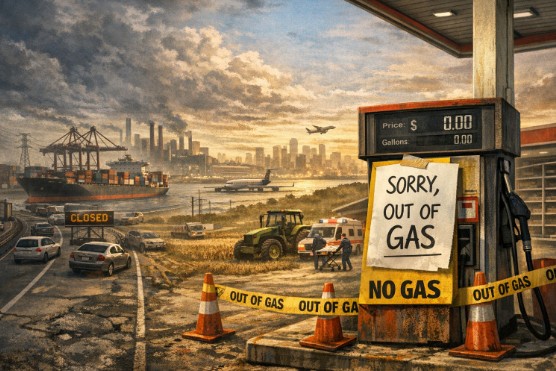
A Nation Built on Fuel Confronts Its Most Fragile Dependency**
When Americans think about gasoline, they tend to picture the price on the corner sign, the pump handle, the morning commute. Few consider the sprawling, fragile system behind it — the refineries, pipelines, tankers, trucks, and global markets that keep the country moving. Fewer still imagine what would happen if that system failed.
Yet energy analysts, emergency planners, and supply‑chain experts warn that a sudden, prolonged loss of gasoline would not simply strand drivers. It would expose how deeply modern life depends on a fuel most people only notice when they need to fill up.
Gasoline is not just a product. It is infrastructure. And without it, the United States would face a cascading crisis that touches nearly every sector of society.
A System Built on Assumptions
For more than a century, the American economy has been organized around cheap, abundant fuel. Ninety percent of U.S. households own a car. Nearly all freight — from groceries to medical supplies — moves by truck at some point in its journey. Police cruisers, fire engines, ambulances, school buses, farm equipment, construction machinery, and airport vehicles all rely on gasoline or diesel.
“We don’t think of gasoline as a critical service like electricity or water,” said one federal emergency planner. “But if it disappears, everything else begins to fail.”
The vulnerability is not theoretical. Short-term disruptions — hurricanes in the Gulf, cyberattacks on pipelines, refinery outages — have shown how quickly panic buying and supply shortages can spread. But those events lasted days. Experts say a true depletion of gasoline would unfold on a scale the country has never experienced.
The First 72 Hours: A Nation Stalls
If gasoline supplies were to run out abruptly, the first signs would appear within hours.
Commuters would be unable to reach workplaces. Delivery drivers would abandon routes. Ride-share services would vanish. Public buses in most cities would halt. Emergency response times would lengthen as police and fire departments rationed what little fuel remained in reserve.
By the third day, grocery stores would begin to empty. Pharmacies would run low on medications. Hospitals would face shortages of oxygen tanks, sterile supplies, and food — all delivered by truck.
“People imagine this as an inconvenience,” said a logistics expert at MIT. “It’s not. It’s a systemic shock.”
A Supply Chain Without Fuel
The American supply chain is a just‑in‑time system. Warehouses keep minimal inventory. Stores rely on daily deliveries. Even farms depend on fuel to operate tractors, irrigation pumps, and transport vehicles.
Without gasoline or diesel:
- Crops cannot be planted or harvested
- Livestock feed cannot be delivered
- Food spoils before reaching markets
- Manufacturing plants shut down for lack of materials
- Ports grind to a halt as cranes and trucks sit idle
The result is not simply scarcity. It is paralysis.
The Global Ripple Effect
The United States is not isolated from the world’s energy markets. A domestic fuel collapse would disrupt international trade, weaken alliances, and destabilize global supply chains.
Cargo ships rely on petroleum-based fuels. So do the trucks and cranes that move containers through ports. A U.S. shutdown would ripple outward, affecting everything from electronics in Asia to grain shipments in Africa.
Energy economists warn that the geopolitical consequences could be severe. Nations dependent on U.S. imports would face shortages. Oil-producing countries would see markets collapse. Financial markets would react violently.
Gasoline, in other words, is not merely a domestic commodity. It is a global stabilizer.
Why Gasoline Still Matters — Even in an Electric Age
Electric vehicles are growing in popularity, but they remain a fraction of the national fleet. Heavy-duty trucks, farm machinery, construction equipment, and emergency vehicles still overwhelmingly run on petroleum.
Charging infrastructure is uneven. Rural areas lack capacity. Long-haul trucking has no scalable electric alternative. And many developing countries rely on gasoline because it is accessible, portable, and requires no grid.
“We are transitioning,” said an energy policy researcher. “But we are not ready for a world without gasoline. Not yet.”
The Long Road to Transition
A future without gasoline is possible — but only with decades of planning.
Experts say the United States would need:
- A fully electrified transportation network
- Nationwide fast-charging infrastructure
- Electric heavy machinery and farm equipment
- Major advances in battery technology
- Expanded renewable energy generation
- A resilient, modernized power grid
The transition is not simply technological. It is economic, political, and cultural.
A Fragile Dependency
Gasoline built the modern American landscape — the suburbs, the highways, the logistics networks, the global trade routes. But that dependence has created a vulnerability few people recognize.
Running out of gasoline would not just change how Americans travel. It would reshape how they live.
The question, energy analysts say, is not whether the country can survive without gasoline. It’s whether it can prepare for the day when it must.
If the U.S. actually ran out of fuel (gasoline/diesel/natural gas), it wouldn’t be one dramatic moment—it would unfold in phases, and it would get serious fast.
Here’s what it would realistically look like 👇
⛽ Phase 1: Panic & Lines (Days 1–5)
The moment people realize there’s a shortage:
- Gas stations get flooded
- Lines stretch for blocks
- Stations start running dry within hours
You’d see a repeat—on a bigger scale—of what happened during the
Colonial Pipeline ransomware attack
👉 People hoarding fuel
👉 Viral videos of fights at pumps
👉 Prices spiking instantly
🚚 Phase 2: Supply Chain Breakdown (Week 1–2)
The U.S. runs on trucks—especially diesel.
- Grocery deliveries slow or stop
- Amazon/UPS/FedEx delays stack up
- Gas stations themselves can’t be resupplied
Within days:
👉 Empty shelves (milk, bread, essentials go first)
👉 Restaurants start closing
👉 Pharmacies struggle to restock
🏙️ Phase 3: Cities Start Feeling It (Week 2+)
Urban areas get hit hardest:
- Public transportation gets cut back
- Ride-sharing disappears
- Workers can’t commute
Major hubs like:
- New York City
- Los Angeles
…would feel it almost immediately due to population density.
⚡ Phase 4: Energy & Power Stress
The U.S. doesn’t rely heavily on gasoline for electricity—but:
- Natural gas shortages can hit power grids
- Rolling blackouts become possible
- Backup generators (hospitals, data centers) run on diesel
In extreme cases:
👉 Hospitals ration power
👉 Internet/data infrastructure gets shaky
👉 Heating/cooling becomes unreliable
🏥 Phase 5: Emergency Services Get Prioritized
The government would step in hard at this point.
Fuel gets redirected to:
- Ambulances
- Fire departments
- Police
- Military
Regular people?
👉 Limited or no access
👉 Strict rationing systems
📉 Phase 6: Economic Shockwave
Within a few weeks:
- Businesses shut down
- Freight movement collapses
- Stock market volatility spikes
You’d likely see:
👉 Inflation surge
👉 Job losses
👉 Supply shortages across industries
⚠️ Phase 7: Social Tension
If it drags on:
- Protests at gas stations and government buildings
- Black markets for fuel
- Possible looting in heavily affected areas
It wouldn’t be instant chaos everywhere—but pressure builds quickly.
🇺🇸 What Prevents This From Happening Easily
The U.S. is actually hard to fully “run out” of fuel because of:
- The Strategic Petroleum Reserve
- Massive domestic oil production
- Multiple supply routes (pipelines, rail, shipping)
So a total nationwide collapse is unlikely—but regional shortages? Very possible.
🧠 Realistic Scenario
More likely than total collapse:
👉 Regional shortages (like the Southeast in 2021)
👉 Temporary panic buying
👉 Short-term supply disruptions
Not Mad Max…
…but definitely stressful and disruptive.
If fuel stopped flowing in the U.S., you wouldn’t notice it when driving first—
You’d notice it when:
- Shelves go empty
- Deliveries stop
- And daily routines quietly fall apart
Because in America, fuel isn’t just transportation…
It’s the system behind the system.