 C. Stewart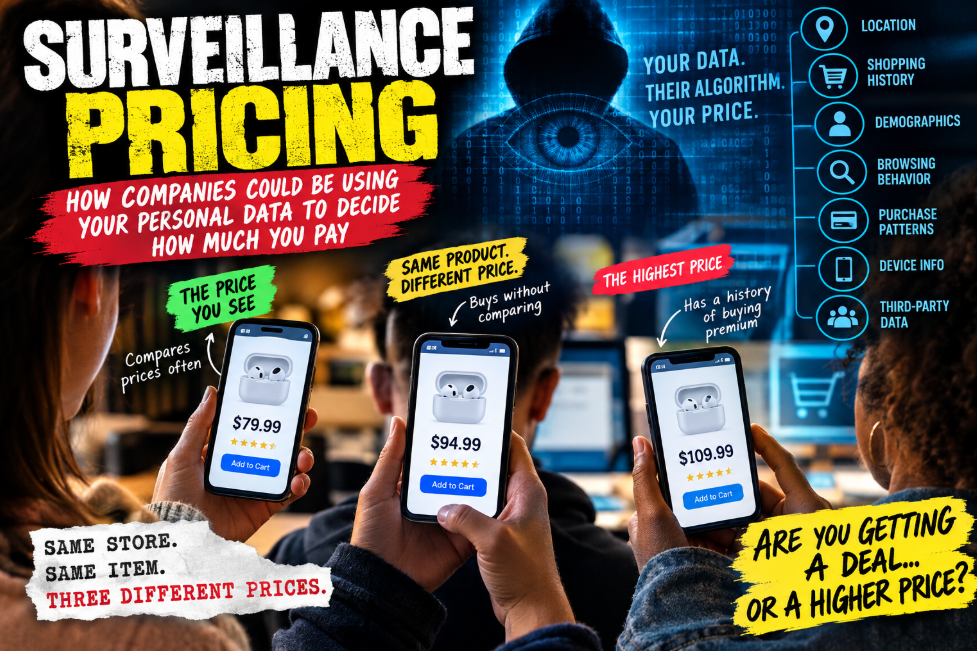
Surveillance Pricing: How Companies Could Be Using Your Personal Data to Decide How Much You Pay
Your shopping habits, browsing history, location, and even your behavior online could be influencing the prices you see. Welcome to the growing controversy surrounding surveillance pricing.
For years, consumers have been told to shop around, compare prices, look for discounts, and never pay more than necessary. But what happens when the company selling you something already knows how much you are willing to spend?
Imagine opening a shopping app and seeing a price of $4.99 for a product. Your neighbor opens the same app, looks at the exact same product, and sees $5.79. Neither of you knows that the other is seeing a different price.
It sounds like something out of a science-fiction movie, but the practice known as surveillance pricing has become a serious subject of investigation by federal regulators.
The concept is relatively simple: Companies can use information collected about consumers to help determine the prices, discounts, or offers presented to them.
And unlike traditional price tags, which generally display the same price to everyone shopping at a particular location, personalized pricing can potentially make the price different from one customer to another.
The question now is whether consumers are getting personalized deals or whether their personal information is being used to determine just how much more they might be willing to pay.
What Exactly Is Surveillance Pricing?
Surveillance pricing is the practice of using personal information, consumer behavior, and technology to determine individualized prices for goods and services.
Companies may use artificial intelligence, algorithms, and data analytics to examine information about customers and estimate their willingness to pay.
Some of the information potentially involved includes:
- Browsing and shopping history.
- Geographic location.
- Previous purchases.
- Demographic information.
- Products placed in shopping carts.
- Device and online behavior.
- Information obtained through third-party data brokers.
The Federal Trade Commission investigated this market and released preliminary findings in January 2025, describing how consumer information could be used to influence individualized prices.
In other words, the information companies collect to understand their customers could also become a tool for determining what those customers are charged.
How Could This Affect Your Wallet?
Let’s look at a hypothetical example.
Three people visit the same online retailer to purchase a household appliance.
All three are looking at the same product, but the company has different information about each shopper.
Customer A: Frequently compares prices, visits competing websites, and waits for sales.
Customer B: Has purchased similar products from the retailer before and regularly buys without comparing prices.
Customer C: Has a history of purchasing premium products and rarely uses discount codes.
An algorithm could potentially use these behavioral patterns to determine which offers or prices each customer sees.
This is an illustration of how personalized pricing might work, not proof that a particular retailer is charging these customers different amounts.
The concern is that a shopper who appears less price-sensitive could receive a higher price or a smaller discount than someone the company believes is more likely to walk away.
And the consumer might never know why.
Is This the Same Thing as Surge Pricing?
Not exactly.
Although the two practices can overlap, there is an important distinction.
Dynamic or surge pricing generally involves prices changing because of market conditions, demand, availability, or timing.
For example, airline tickets may become more expensive as seats sell out. Rideshare prices may rise when demand increases.
Surveillance pricing involves using information about a particular consumer or consumer group to influence the price they are offered.
The difference is the information being used.
One changes prices based on market conditions. The other may use personal data to estimate what an individual customer will pay.
That distinction is at the center of the current regulatory debate.
The FTC Gets Involved
The Federal Trade Commission began examining surveillance pricing in 2024, issuing information demands to eight companies involved in pricing technology and related services.
The investigation sought information about how companies use personal data, artificial intelligence, and other technologies to influence prices.
In January 2025, FTC staff released preliminary findings describing the variety of information that pricing intermediaries could use, including browsing behavior, location, demographics, and shopping activity.
The issue continued to receive federal attention.
In August 2026, the FTC announced a proposed enforcement policy concerning personalized pricing. The proposal says that failing to disclose the use of personal data to set prices could violate consumer protection laws in certain circumstances.
The agency has also acknowledged that it does not have authority to prohibit every form of personalized pricing.
The debate is therefore not simply about whether companies can change prices. It is about transparency, consumer expectations, and how personal information is used.
Could This Happen at the Grocery Store?
Groceries are among the areas receiving attention because food is something consumers cannot simply stop purchasing.
Consider a family that regularly buys milk, eggs, bread, and other necessities.
If a retailer uses information about household composition, purchasing patterns, or other personal characteristics to influence prices, consumers could have difficulty determining whether the price reflects ordinary market conditions or individualized pricing.
This is one of the concerns raised in the FTC’s 2026 proposed policy.
It is important to distinguish the concern from an established finding that grocery stores are routinely charging individual families different prices for the same products based on personal data.
However, the possibility has prompted investigations, public debate, and calls for stronger consumer protections.
Who Benefits From Surveillance Pricing?
From a business perspective, personalized pricing can provide information about consumer demand, help target discounts, and potentially increase revenue.
Companies may argue that data-driven pricing can also help them offer promotions to customers who are more price-sensitive.
But critics have raised concerns about whether consumers could be disadvantaged when companies possess significantly more information about their purchasing behavior than shoppers have about the pricing system.
The central questions include:
- Are customers being treated differently based on personal information?
- Are companies clearly disclosing how prices are determined?
- Could vulnerable consumers face higher costs?
- Can shoppers meaningfully opt out?
- How can consumers verify that they are receiving the same price as everyone else?
These questions become particularly important when the products involved are everyday necessities rather than optional purchases.
How Can Consumers Protect Themselves?
There is no guaranteed way to prevent a company from using all the information it has collected about you. However, consumers can take practical steps to limit exposure and compare prices.
1. Compare prices across retailers. Don’t assume the first price you see is the only available price.
2. Check prices before logging into an account. Comparing a logged-in price with a public listing may help identify differences, although it does not prove why a price changed.
3. Review privacy settings. Limit unnecessary tracking and data sharing where possible.
4. Be cautious with loyalty programs. Understand what shopping information you are agreeing to share in exchange for rewards or discounts.
5. Watch for unexplained price differences. Keep screenshots or records if you encounter significantly different prices for the same product under comparable conditions.
6. Pay attention to consumer protection developments. Federal and state regulators continue examining personalized pricing practices.
Private browsing or a VPN may change some of the information a website receives, but neither guarantees that you will receive a lower price or avoid personalized pricing.
The Bigger Issue: Who Really Controls the Price?
For generations, shopping meant looking at a price tag and deciding whether something was worth the money.
Today, businesses have access to increasingly detailed information about how consumers behave online.
That information can help companies understand what customers want, what they buy, and how they respond to promotions.
But when that same information is used to influence the amount someone pays, a new question emerges: How much should a company know about a customer before that knowledge becomes a pricing tool?
Surveillance pricing sits at the intersection of technology, privacy, business strategy, and consumer protection.
It does not mean every price difference is the result of spying on shoppers. Nor does it mean every personalized offer is harmful.
But consumers have a legitimate interest in knowing when their personal information is being used to determine what they pay.
Because the next time you see a price increase, it may be worth asking whether the market changed—or whether the company simply learned something new about you.
Sources and Further Reading
- Federal Trade Commission — Surveillance Pricing: Research and Investigations
- Federal Trade Commission — January 2025 Initial Findings on Surveillance Pricing
- Federal Trade Commission — August 2026 Proposed Policy on Personalized Pricing
This article discusses the practice and regulatory debate as of October 2026. The FTC policy described above was proposed for public comment, not a blanket federal ban on personalized pricing.

 fbj_Admin