 C. Stewart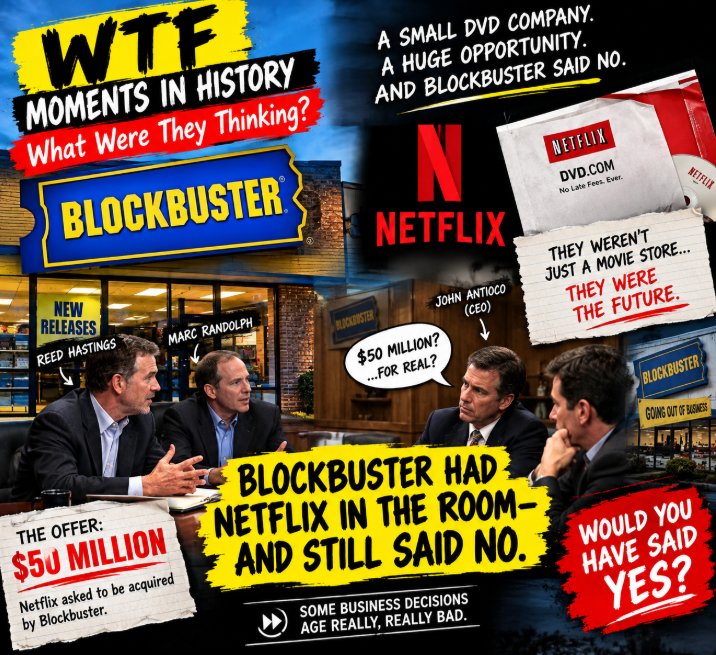
Blockbuster Had Netflix in the Room—and Still Said No
There are bad business decisions.
There are really bad business decisions.
And then there are the decisions that become legendary because the company involved eventually disappears while the company it could have owned becomes one of the biggest entertainment businesses on Earth.
Welcome to another WTF Moment in History.
This is the story of Blockbuster and Netflix.
And yes, it really happened.
WHAT HAPPENED?
Back in 2000, Blockbuster was the king of home entertainment.
If you wanted to watch a movie at home, chances were pretty damn good you were walking into a Blockbuster.
Netflix, meanwhile, was still a tiny, struggling DVD-by-mail company.
Netflix had been founded in 1997, and its business model was simple: instead of driving to a video store, customers could order DVDs online and have them delivered through the mail.
Today that sounds completely normal.
In 2000, it looked like a strange little internet experiment.
Netflix was also losing money.
A LOT of money.
The dot-com crash was making investors nervous, and Netflix was nowhere close to becoming the streaming monster it would eventually become.
Blockbuster, on the other hand, had thousands of stores and enormous brand recognition.
From Blockbuster’s perspective, Netflix probably looked less like the future of entertainment and more like a struggling internet company trying to survive.
And that’s where things get interesting.
THE MEETING
In 2000, Netflix executives including Reed Hastings and Marc Randolph met with Blockbuster executives in Dallas.
According to Randolph’s account, Netflix proposed combining forces.
The basic idea was almost ridiculously simple in hindsight:
Blockbuster could handle the physical stores. Netflix could handle the online business.
Netflix would bring the technology and online expertise while Blockbuster brought its enormous customer base and physical infrastructure.
It was essentially an opportunity to combine the old world with the emerging digital world.
Blockbuster wasn’t interested.
But then came the question that makes this story legendary.
Blockbuster’s general counsel asked what Netflix would cost to acquire.
Hastings reportedly answered:
$50 million.
And that’s when this story enters WTF territory.
According to Randolph’s account, Blockbuster CEO John Antioco appeared to struggle not to laugh at the offer.
The deal didn’t happen.
Netflix went home.
And Blockbuster continued doing what Blockbuster did best:
Running video stores.
THE WTF MOMENT
Here’s where history gets downright cruel.
Blockbuster had a chance to get involved with Netflix when Netflix was still small, struggling and vulnerable.
Instead, the company essentially looked at the future and said:
“Nah.”
To be fair, it’s easy to mock the decision today.
In 2000, Netflix wasn’t Netflix.
There was no Netflix streaming service.
There wasn’t a library of original shows.
There wasn’t a worldwide entertainment empire.
There were DVDs being mailed to people’s houses.
Blockbuster executives weren’t necessarily crazy for thinking the business model was questionable.
Netflix itself was struggling.
But that’s exactly what makes the story so fascinating.
The people at Blockbuster didn’t have the benefit of hindsight.
They had to recognize a technological shift before it became obvious to everybody else.
And they didn’t.
BUT BLOCKBUSTER WASN’T COMPLETELY BLIND
This is where the popular version of the story leaves out some important details.
Blockbuster eventually recognized Netflix as a serious threat.
In 2004, the company launched Blockbuster Online.
In 2005, Blockbuster eliminated late fees in an attempt to compete more aggressively.
And in 2006, Blockbuster launched its Total Access program, which allowed customers to combine online DVD rentals with physical-store exchanges.
For a while, Blockbuster actually fought back.
One analysis of the company’s strategy notes that Blockbuster’s Total Access program initially allowed it to compete extremely effectively with Netflix. (Inc.com)
The problem?
Blockbuster had a massive physical retail operation to support.
Netflix didn’t.
Blockbuster was trying to transform an enormous brick-and-mortar business while Netflix was building its business around the internet.
WHAT HAPPENED NEXT?
Netflix kept evolving.
Eventually, DVDs became yesterday’s technology.
Netflix moved toward streaming.
Blockbuster struggled to make the transition.
The company filed for bankruptcy protection in 2010.
The once-mighty video-rental empire was essentially finished.
The last company-owned Blockbuster stores disappeared, leaving the brand as a nostalgic reminder of an era when renting a movie meant physically going somewhere to get it. (Inc.com)
And Netflix?
Netflix went from mailing DVDs to becoming one of the world’s biggest entertainment companies.
That’s the part that makes the Blockbuster story so brutal.
LOOKING BACK
It’s tempting to say:
“Blockbuster could have bought Netflix for $50 million and become Netflix.”
But history isn’t quite that simple.
Netflix was a risky, money-losing startup in 2000. Blockbuster wasn’t stupid for questioning whether an online DVD business could become enormous.
The mistake wasn’t necessarily failing to predict Netflix’s exact future.
The bigger mistake was failing to recognize that the way people consumed entertainment was changing.
Blockbuster had the customers.
It had the brand.
It had the money.
It had thousands of locations.
What it didn’t have was the willingness—or perhaps the organizational ability—to completely reinvent itself before the old business model became obsolete.
Netflix did.
THE VERDICT
WTF LEVEL: 10/10
Not because Blockbuster was stupid.
Because the company was sitting across a table from a tiny company that represented a completely different future of entertainment—and didn’t understand just how important that future could become.
Blockbuster wasn’t killed by one bad decision.
There were years of decisions, financial pressures, competition and technological changes that contributed to its collapse.
But that 2000 meeting has become the ultimate symbol of corporate hindsight.
A struggling little DVD company walked into Blockbuster’s headquarters and basically said:
“Let’s build the future together.”
Blockbuster said no.
Netflix went on to build the future anyway.
And somewhere in the history of business, there is probably still a giant neon sign hanging over that meeting room:
“YOU HAD ONE JOB.”
That gives the series a strong second episode after Dennis Miller: one bizarre entertainment decision and one legendary business decision. The Blockbuster story also gives you plenty of room for a graphic built around the $50 million offer, the Blockbuster logo, Netflix’s early DVD envelopes, and the question “WOULD YOU HAVE SAID YES?” (Inc.com)