 C. Stewart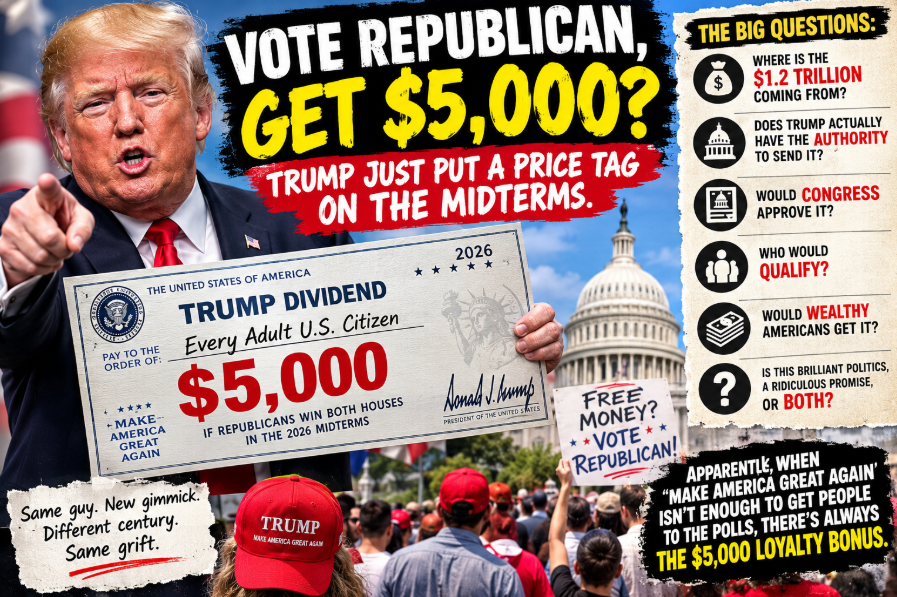
Trump announced on September 9 that if Republicans retain control of both the House and Senate in the November 2026 midterms, he would issue a $5,000 “Trump dividend” to every adult U.S. citizen. He did not explain exactly how it would be funded or how Congress would authorize it. (Reuters)
The first thing I’d point out
Trump didn’t literally say, “Vote Republican and I personally will give you $5,000.” His stated condition was that Republicans win both chambers.
But he absolutely connected the money to the election. He said, in substance, “If the Republicans win, you win with us and you get $5,000.” He also urged people to treat the election as though he himself were on the ballot. (WIRED)
That’s why you’re seeing people characterize it as essentially “vote for us and get a check.”
The $1.2 trillion problem
There are roughly 240 million adult U.S. citizens. At $5,000 each, that’s approximately:
240 million × $5,000 = $1.2 trillion.
And that’s before considering administrative costs or whether wealthy Americans would be excluded. Vice President JD Vance subsequently suggested that higher-income Americans might not receive the payment. (AP News)
That’s a massive amount of money.
The other major problem is funding. Trump didn’t provide a detailed funding mechanism. Tariff revenue has been mentioned as a potential source, but current tariff collections aren’t remotely large enough by themselves to cover a $1.2 trillion annual-style payout. (WIRED)
Is it actually “buying votes”?
Legal experts quoted in the reporting have said it isn’t necessarily illegal vote buying because Trump didn’t condition an individual person’s payment on that individual voting Republican. The condition is that Republicans as a party win the election. (AP News)
But politically and ethically, there’s an obvious question:
What is the practical difference between saying “Vote Republican and you get $5,000” and saying “If Republicans win, everybody gets $5,000”?
That’s the controversy.
And there’s another interesting wrinkle: Congress would have to be involved. The president doesn’t simply have the authority to wake up after Election Day and order $1.2 trillion in checks to Americans. Congress would have to authorize the spending.
So the promise isn’t really:
“Trump will give you $5,000.”
It’s closer to:
“Trump is promising to pursue a $1.2 trillion government payment if Republicans win, assuming Congress goes along with it and the funding can be found.”
And there’s history here
This isn’t the first time Trump has floated a giant check for Americans.
He’s previously promoted ideas involving tariff-funded payments, including a proposed $2,000 tariff dividend, and a number of those proposals never became reality. (Business Insider)
“Trump is bribing voters.”
That’s legally loaded and gives people an easy way to dismiss the story.
Instead:
“Vote Republican, Get $5,000? Trump Just Put A Price Tag On The Midterms”
Where is the $1.2 trillion coming from?
Does Trump actually have the authority to send it?
Would Congress approve it?
Who would qualify?
Would wealthy Americans get it?
And is promising Americans a giant check immediately before an election good politics, bad economics, or both?
“Apparently, when ‘Make America Great Again’ isn’t enough to get people to the polls, there’s always the $5,000 loyalty bonus.”


 fbj_Admin